 CompanySweeper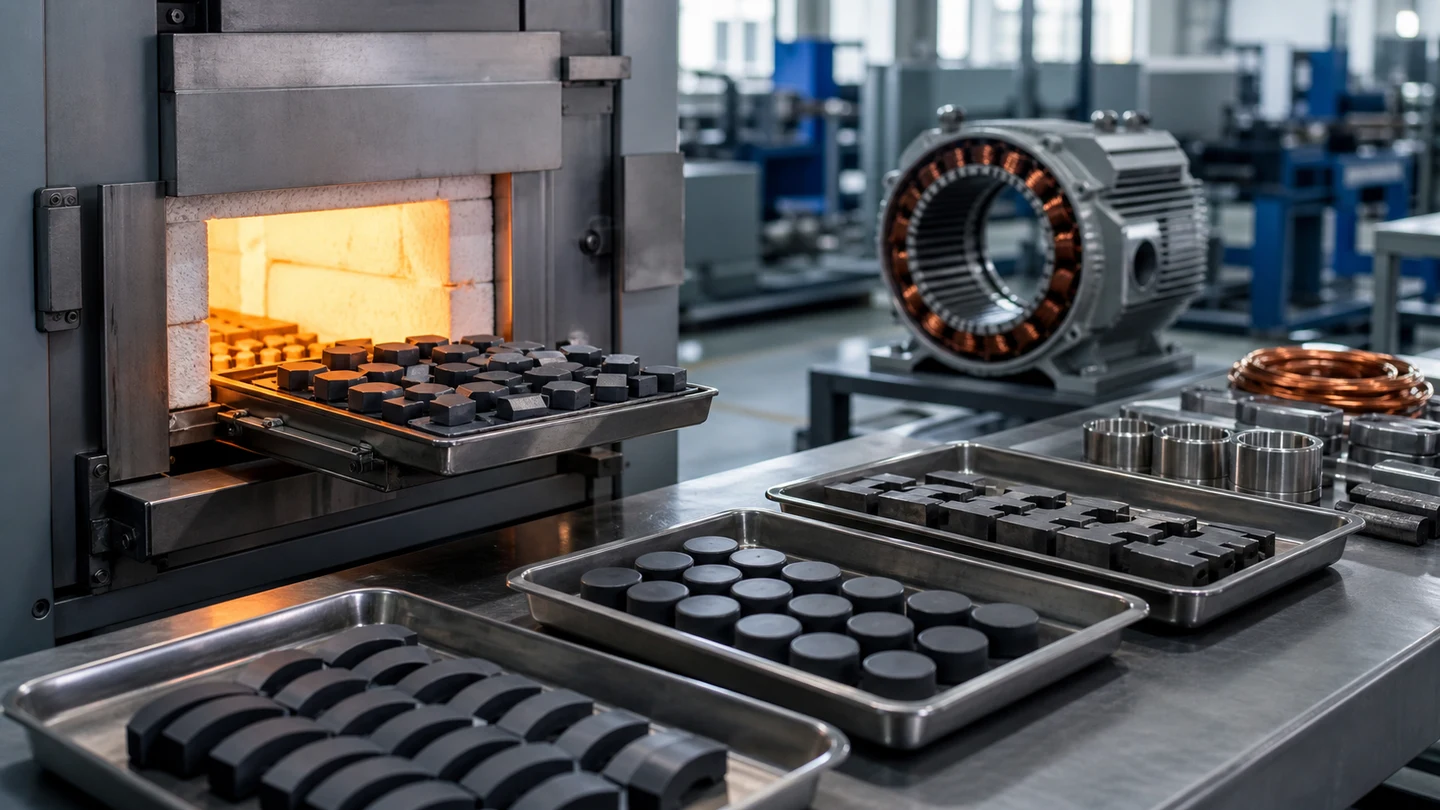
The catalyst
The Ministry of Heavy Industries received 20 bids for a ₹7,280-crore scheme to build integrated plants for sintered rare-earth permanent magnets, with a target of 6,000 metric tonnes a year across as many as five companies. That is a real procurement milestone, but it is not yet a factory, a customer order or a tonne of operating output. The bid count tells us that the policy has attracted interest; it does not identify the eventual manufacturers.News sourcetrucksbuses.com
The economic mechanism is straightforward and demanding: a usable magnet supply must move from eligible bidder to qualified plant, then into motors and other equipment without losing consistency or cost competitiveness. That could reduce one supply-chain constraint for electric vehicles and industrial equipment, but the saved Discovery packet found no Core company with a proven link to this scheme. The better question is therefore where listed companies sit near the chain—and what evidence would turn proximity into exposure.News sourcestrucksbuses.comstraitstimes.com
In brief
What matters
- Bids are only the gateThe 20 bids create a qualification and execution pipeline; bidder selection, construction, commissioning and output remain unreported.
- The closest listed boundaryPermanent Magnets makes magnetic alloys and magnet sub-assemblies, but its saved company evidence does not prove participation in the government scheme.
- Motors add a different testPitti Engineering supplies laminations and stator and rotor assemblies to OEMs; its link is a component-demand comparison, not evidence that it will make rare-earth magnets.
- Downstream demand is conditionalPrecision Camshafts is pursuing niche electric drivelines for medium and heavy commercial vehicles, making it a useful end-market boundary rather than a confirmed magnet customer.
Company landscape
How the catalyst reaches listed businesses
Which Indian-listed companies are closest to the economic chain created by India's ₹7,280-crore rare-earth permanent-magnet manufacturing scheme, and what evidence distinguishes a magnet producer from motor and EV-component adjacencies?
The supply-chain gap is the story
Permanent magnets are not interchangeable with every magnetic material. The saved news evidence describes their use in electric vehicles, wind turbines and defence equipment, while the scheme itself is aimed at integrated manufacturing rather than a simple trading or assembly capacity. That distinction matters because a plant can satisfy a headline capacity target and still need time to qualify composition, consistency and performance with downstream equipment makers.News sourcesstraitstimes.comtrucksbuses.com
The missing facts are unusually important here. The saved signal does not name the 20 bidders, set out the implementation timetable, or show how the 6,000-MTPA target compares with Indian demand. Until those facts arrive, the most defensible read-through is that India is trying to add a domestic option in a specialised input whose commercial value depends on qualification and dependable delivery—not merely on installed tonnes.News sourcetrucksbuses.com
Permanent Magnets is the nearest listed boundary
Permanent Magnets Ltd is the closest adjacent company in the saved evidence because it makes magnetic alloys from virgin metal and scrap and supplies magnet sub-assemblies. Its FY26 standalone revenue was ₹225 crore, and management said a new alloys furnace was installed in January; the company is also investing ₹50 crore in a Quantum Magnetics factory setup. These facts make its operations useful for understanding the manufacturing step the policy is trying to encourage.
The boundary is just as important as the match. Its assembly business generated zero revenue in FY26 because of Chinese export restrictions on magnets, and the company still faces Chinese competition in EV applications. The evidence therefore supports a magnet-manufacturing comparison, not a claim that the company won a scheme allocation. The next useful disclosure would be a named customer, a qualified product, or an order tied to the new facility—not another broad localisation ambition.
Motor and vehicle companies show the conversion risk
Pitti Engineering Ltd sits one step downstream. It manufactures electrical-steel laminations, stator and rotor cores and higher-value assemblies for global OEMs across industrial motors, power, railways and data centres. FY26 revenue was ₹1,953 crore, and its saved presentation describes it as a supplier to motor manufacturers. That makes Pitti an adjacent motor-component contrast: domestic magnet availability could change input options for some motor programmes, but the evidence does not say Pitti will source or integrate magnets from this scheme.
Precision Camshafts Ltd gives the chain a different endpoint. It makes camshafts, balancer shafts and injector components, while its saved management discussion describes integrated electric drivelines and a focus on niche public-service, infrastructure and utility applications in the 10-to-30-tonne commercial-vehicle segment. That is an adjacent downstream EV comparison: more local motor inputs could eventually help vehicle economics, but no saved record identifies the company as a customer or quantifies any magnet content in its driveline work.
Taken together, these companies show why the bid announcement is an industrial test rather than an instant earnings event. Permanent Magnets makes the closest material step visible; Pitti shows the motor-component layer that needs reliable specifications; Precision Camshafts shows how an eventual cost or availability change would still have to pass through a vehicle programme. The three links are useful precisely because none is evidence of a direct award.
Questions for the next filing
What would prove the connection?
- 1
Which companies actually make magnetic materials or motor components?
- 2
Where does the saved evidence show a direct scheme link, and where is the connection only conditional?
- 3
What would prove that announced capacity is becoming usable commercial supply?
Risks and limits
What could break the argument?
- The 20 bids may not convert into selected bidders, funded plants, commissioning or operating output, and the saved signal supplies no timetable.
- Even commissioned capacity may take time to qualify with motor and vehicle customers; the saved evidence does not establish demand, pricing or customer commitments for the target output.
- The closest listed company still reports exposure to Chinese competition and export restrictions, so domestic policy support does not remove technology, input or execution risk.
Keep following the thread
What we would check next
- The Ministry of Heavy Industries naming selected bidders and publishing award conditions.
- Construction, commissioning and first qualified output against the 6,000-MTPA target.
- Customer qualification, order announcements and product-level evidence at Permanent Magnets and downstream motor or EV suppliers.
- Whether domestic magnet availability changes procurement cost, lead times or specifications for motor and commercial-vehicle programmes.
Have a catalyst or business question of your own?
Use CompanySweeper to find the companies behind it.
Try this question free →Research basis · 10 records reviewed
The narrative was checked against 8 company records and 2 topical sources. News links also appear beside the paragraphs that rely on them.
Research for idea discovery, not a recommendation to buy or sell securities.