 CompanySweeper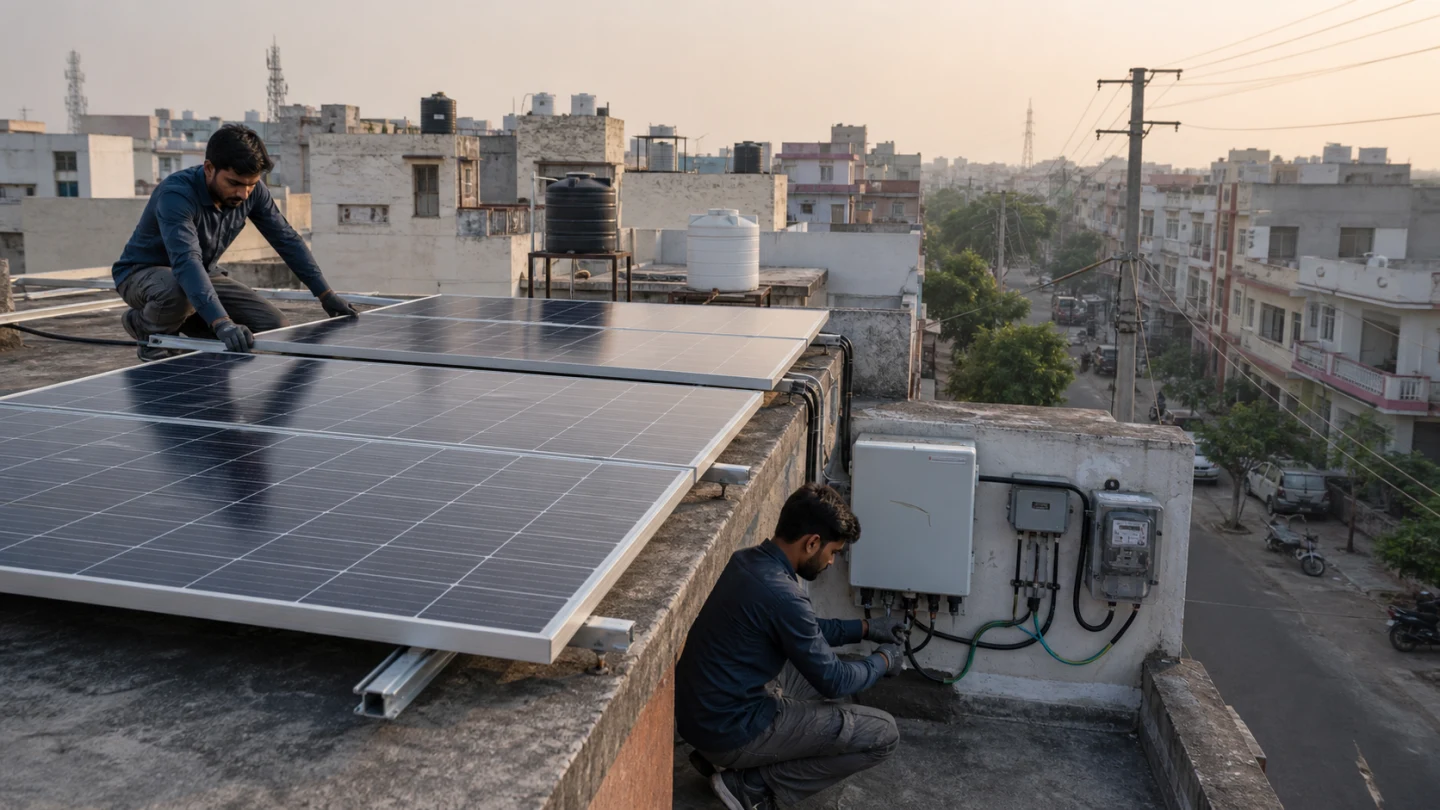
The catalyst
The Asian Development Bank has approved an $850 million loan for the second subprogram supporting India’s PM Surya Ghar rooftop-solar scheme. The programme aims to reach 10 million low- and middle-income households, add 30 GW of residential rooftop capacity by FY27 and finance at least 3.5 million installations. The package also supports digital monitoring, distribution-company participation and workforce training.News sourcessolarquarter.comThe Economic Times
The economic question is whether financing shortens the journey from a household application to an energised, paid-for system. Revenue reaches listed companies only when discom approvals, vendor fulfilment, equipment availability and payment cycles work together. That makes the clearest exposures the businesses connecting residential customers to installations, the manufacturers feeding those channels and the contractors whose margins show where execution breaks.News sourcesolarquarter.com
In brief
What matters
- The scaleThe loan supports a live installation programme. Reported progress already includes 18.71 lakh systems installed in FY26 and 6.7 GW of cumulative capacity.
- The closest linkResidential vendors with installation and distribution capabilities can turn household demand into complete systems rather than sell one undifferentiated component.
- Supply is not enoughModule makers can gain volume, but utilisation, product mix and execution matter more than assuming that policy support creates scarcity.
- Cash decidesDelays, input costs and receivable cycles can absorb a larger project pipeline. Order growth must be checked against margin and working capital.
Company landscape
How the catalyst reaches listed businesses
Which Indian-listed companies are directly exposed to residential solar demand, module and inverter offtake, and the rooftop EPC pipeline created by the ADB-backed PM Surya Ghar rollout?
The loan is a throughput test
The headline amount matters because it sits beside an existing subsidy machine rather than a standing start. Reporting says ₹27,343.90 crore of central financial assistance has already been released under the scheme. Another report says 18.71 lakh rooftop systems were installed during FY26, taking cumulative capacity to 6.7 GW. The ADB programme must therefore accelerate a live chain: household origination, financing, subsidy processing, technical approval, installation, grid connection and payment.News sourcesmoney.rediff.comnewsstreetlive.com
A sovereign loan does not map neatly to module sales. The saved signal does not specify the disbursement schedule, conditions or allocation among implementing entities. It does specify digital monitoring and discom and private-sector participation. The near-term evidence should appear in installation volumes, vendor throughput and payment behaviour before it appears as a durable manufacturing uplift.News sourcessolarquarter.comtimesofindia.indiatimes.com
Three companies sit at different points in the chain
Solarium Green Energy is the closest operating match to the household conversion problem. Its presentation calls it the second-largest PM Surya Ghar vendor among more than 20,000 vendors and says it is expanding into complete solar kits. Residential rooftop contributed ₹80 crore in FY26 and distribution ₹61 crore, although management said growth came mainly from larger EPC execution. Investors should therefore ask whether residential and kit volumes, rather than unrelated ground-mounted work, are driving the next leg.
Insolation Energy sits one step upstream while retaining an execution arm. Management reported 5.5 GW of module capacity and demand across rooftop, EPC, government and channel-partner segments. Its presentation describes a pan-India retail network and relationships with government schemes, discoms, EPC contractors and developers. That breadth can lift factory utilisation, but it prevents clean attribution to PM Surya Ghar. The sharper test is utilisation and sales mix while its planned 4.5 GW TOPCon cell project targets commissioning in Q3 FY27.
RMC Switchgears defines the boundary. Its solar EPC work includes rooftops, but the company is mainly exposed to government and utility execution. FY26 revenue grew 26.4%, while profitability suffered from project delays, input costs and product-development spending. Its solar EPC order book was ₹125 crore with ₹400 crore in active tenders. Policy-backed demand and a visible tender funnel still do not guarantee margin or cash conversion.
The bottleneck moves downstream
If the programme works, its most valuable contribution may be repeatable throughput rather than a one-off order surge. Solarium should show whether household acquisition and complete-kit distribution can scale. Insolation should show whether that demand lifts utilisation without being hidden by utility-scale and government channels. RMC should show whether contractors can protect margins and working capital when public-sector execution is uneven.
The useful facts are concrete: the ADB disbursement timetable, monthly installations and connected capacity, the time from application to commissioning, subsidy payment behaviour, Solarium’s residential and distribution revenue, Insolation’s utilisation and cell-project commissioning, and RMC’s order conversion and margin. Financing has enlarged the order pool. These disclosures will show whether it has improved the economics.News sourcesolarquarter.com
Questions for the next filing
What would prove the connection?
- 1
Where does the financing translate into company revenue most directly?
- 2
Which operating evidence distinguishes residential exposure from broad solar adjacency?
- 3
What could prevent installations from becoming profitable, cash-converting orders?
Risks and limits
What could break the argument?
- The saved reporting does not provide the ADB loan’s disbursement schedule, conditions or allocation, so the timing of incremental demand remains uncertain.
- Discom participation, approvals and monitoring reforms may not advance at the same speed across states, delaying commissioning and subsidy-linked cash flows.
- Capacity expansion and tender growth can dilute returns if utilisation, input-price protection, margins or working-capital discipline deteriorate.
Keep following the thread
What we would check next
- ADB disbursement milestones and implementing conditions
- Monthly household installations, connected capacity and subsidy turnaround
- Solarium’s residential and distribution mix, and Insolation’s utilisation
- RMC’s solar order conversion, margins and working-capital days
Have a catalyst or business question of your own?
Use CompanySweeper to find the companies behind it.
Try this question free →Research basis · 11 records reviewed
The narrative was checked against 6 company records and 5 topical sources. News links also appear beside the paragraphs that rely on them.
- ADB approves $850 million for PM Surya Ghar rooftop solar29 July 2026
- ADB approves $1.85 billion in financing for India28 July 2026
- PM Surya Ghar assistance and solar curtailment update28 July 2026
- FY26 rooftop installations under PM Surya Ghar28 July 2026
- ADB financing for India’s rooftop-solar expansion28 July 2026
Research for idea discovery, not a recommendation to buy or sell securities.