 CompanySweeper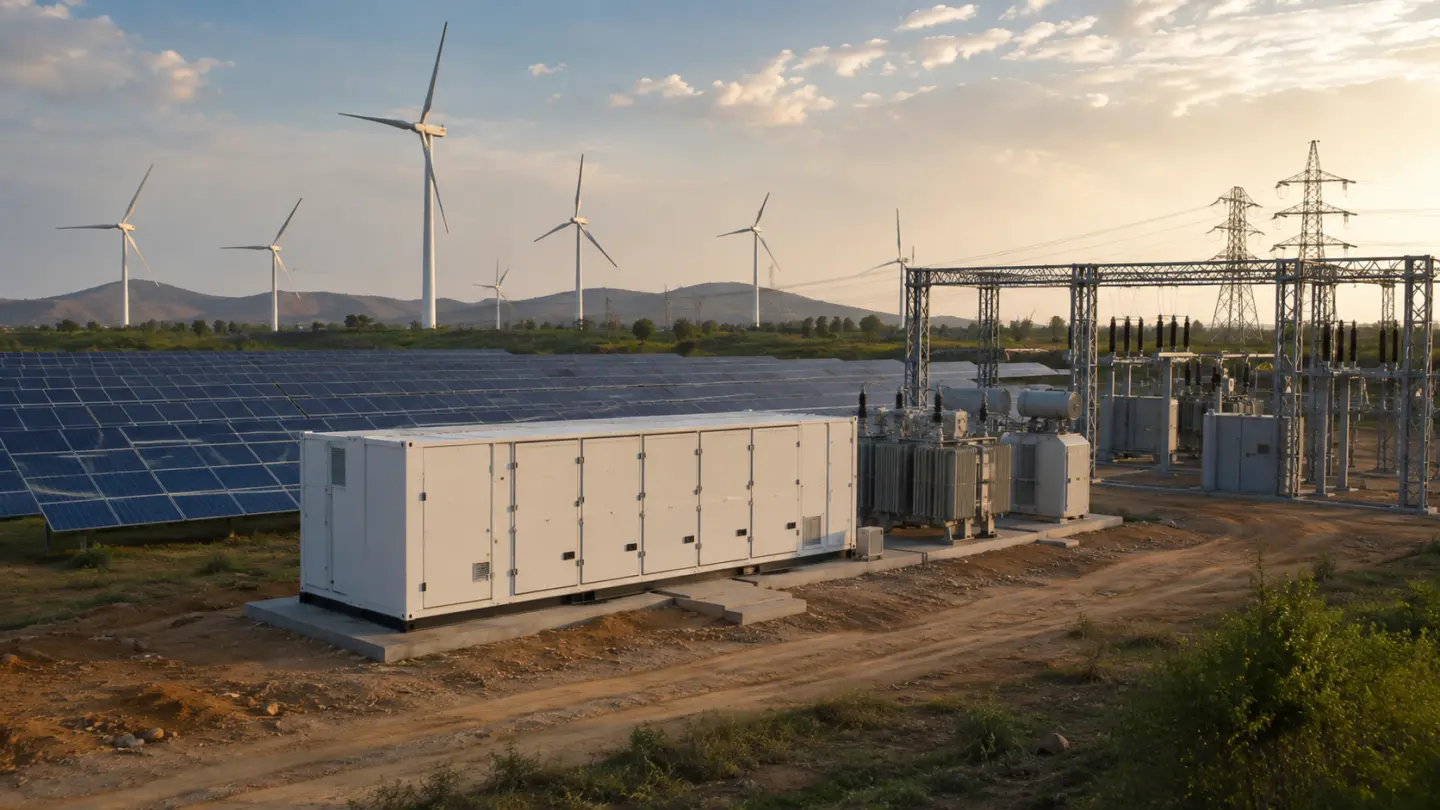
The catalyst
India’s Central Electricity Authority has proposed that ground-mounted solar and onshore wind projects commissioned after July 1, 2027 install co-located storage equal to at least 10% of capacity, with two hours of duration. It has also proposed that 15% of inverters at qualifying renewable plants have grid-forming control. The draft matters because a solar megawatt that cannot move output into an evening peak is less useful than its nameplate suggests. The rule would put a price on that missing flexibility before a project is built.News sourcessolarquarter.comtimesofindia.indiatimes.com
That creates a sharper business question than whether India’s renewable capacity will grow. Developers may need batteries, power-conversion systems and controls that support the grid, while suppliers must deliver them at a cost the project can carry. The saved evidence points to companies already building parts of that chain. It does not show that any has won work because of this draft, or that the proposal will survive unchanged into final standards.News sourcestimesofindia.indiatimes.comindependent.co.uk
In brief
What matters
- The rule changes the productNew renewable capacity would increasingly be sold as a timed, grid-supporting system rather than as panels or turbines alone.
- Manufacturing is the first bottleneckGP Eco and Advait have disclosed indigenous BESS or power-conversion manufacturing plans, but planned gigawatt-hours are not booked revenue.
- Execution decides who captures spendSolarworld and Oriana show different routes into the market: BESS EPC and renewable-asset development with storage in the system.
- The draft leaves economics openFinal compliance, cost recovery, procurement terms and evidence of reduced curtailment will matter more than the headline percentage.
Company landscape
How the catalyst reaches listed businesses
Which Indian-listed companies make the CEA’s proposed storage and grid-forming inverter standards economically concrete through manufacturing, EPC execution or renewable asset ownership?
Storage turns renewable capacity into a scheduling problem
The proposed two-hour minimum matters for what it forces a project to include. Batteries, battery-management systems, inverters, transformers, protection and controls become part of the plant’s economics. Grid-forming capability means the inverter must help stabilise electrical conditions, rather than simply follow a grid voltage created elsewhere. Reporting on unused solar power supplies the reason: generation can be curtailed even when demand is high if timing and grid capability do not match.News sourcessolarquarter.comindependent.co.uk
For investors, the consequence is a shift in capital spending. A developer can meet a megawatt target and still need equipment, engineering and working capital to meet a dispatch requirement. The winning supplier may integrate a complete system and stand behind performance, not simply offer the largest cell or module ambition.News sourcessolarquarter.comtimesofindia.indiatimes.com
Four ways listed companies could meet the requirement
GP Eco Solutions is the most direct equipment example. Its Invergy business has designed, manufactured and commissioned a 1 MWh indigenous BESS, including battery racks, the management system, power-conversion system, transformer and switchgear. Management has described a gigafactory intended to lift BESS capacity from 500 MWh toward 3 GWh and eventually 5 GWh. If the proposal becomes a procurement rule, this integrated capability could matter because the customer needs a working electrical system, not a battery pack in isolation. The test is whether commissioning examples become repeat orders at acceptable margins.
Advait Energy Transitions combines specialised conductors and EPC work with a renewable division establishing a 2.5 GWh BESS facility and dedicated battery subsidiary. That gives it a possible bridge between storage and network infrastructure. It reported Q4FY26 revenue of ₹228 crore and an EBITDA margin of 12.61%, figures describing the existing business rather than revenue from this draft standard. The question is whether its capabilities reach utility-scale customers before 2027.
Solarworld Energy Solutions is closer to the project interface. It executes solar EPC and O&M work, operates both customer-funded CAPEX and company-owned RESCO models, and has disclosed a 3.4 GW BESS line ready for launch. Its presentation records 325 MW/650 MWh of BESS projects from RRVUNL and GUVNL. That makes it an execution case: storage demand can lift equipment sales, but project ownership can add capital intensity and performance risk. The evidence supports existing BESS activity; it does not prove that the CEA draft caused those awards.
Oriana Power sits downstream as a renewable developer and EPC provider. Its saved presentation describes more than 575 MW delivered, more than 550 MW under execution and 800+ MWh of BESS projects won or under execution. That makes it a way to examine whether batteries improve generated-power value and project bankability, rather than only whether equipment factories fill. It is exposed to financing, construction and operating performance: storage can support dispatch, but it does not automatically create a better return.
The evidence gap is where the investment work begins
The proposed standard is not yet a confirmed order pipeline. The CEA may change the percentage, duration, commissioning date or grid-forming threshold. Even if the rule is notified, developers may recover the cost through tariffs, absorb it through lower returns or delay projects. The saved news does not establish how stored electricity will be sold, who will pay for ancillary grid services or whether equipment will reduce curtailment enough to offset its cost.News sourcessolarquarter.comtimesofindia.indiatimes.comindependent.co.uk
The four companies carry different failure modes. Equipment makers must commission factories, qualify products and manage warranties. EPC companies must deliver systems without a working-capital trap. Asset owners must finance batteries through degradation. The comparison is who converts BESS into delivered megawatt-hours, repeat customers and cash generation.
Questions for the next filing
What would prove the connection?
- 1
Which companies already manufacture BESS or power-conversion equipment rather than merely discussing storage?
- 2
Which operators can convert storage into dispatchable renewable power without overstretching capital?
- 3
What disclosures would show that the draft rule is becoming revenue, orders or cash flow?
Risks and limits
What could break the argument?
- The CEA standards are draft proposals; a changed or delayed rule could reduce the near-term procurement signal.
- Storage adds batteries, controls, degradation and financing costs; mandated installation does not guarantee tariffs, utilisation or acceptable project returns.
- Manufacturing capacity plans and announced BESS projects may require further qualification, commissioning and working capital before they become recurring revenue.
Keep following the thread
What we would check next
- Final CEA standards: storage percentage, duration, commissioning date and grid-forming definition.
- Tender documents showing storage, PCS and control-system specifications rather than solar capacity alone.
- Factory commissioning, utilisation and customer orders reported by GPECO and ADVAIT.
- BESS execution, dispatch performance, margins and working-capital movement at SOLARWORLD and ORIANA.
- Evidence that curtailed renewable power is being shifted into paid peak-period or grid-support services.
Have a catalyst or business question of your own?
Use CompanySweeper to find the companies behind it.
Try this question free →Research basis · 12 records reviewed
The narrative was checked against 8 company records and 4 topical sources. News links also appear beside the paragraphs that rely on them.
- CEA Proposes 15% Grid-Forming Inverters And Mandatory ESS For Renewable Projects From 2027 - SolarQuarter3 September 2026
- CEA proposes mandatory storage for solar, wind projects | The Times of India3 September 2026
- Rs 5,070-crore bet: Can floating solar power India’s next renewable leap?3 September 2026
- India’s power demand is surging, but some solar energy is going to waste2 September 2026
Research for idea discovery, not a recommendation to buy or sell securities.